Papers

Where the work has landed so far.

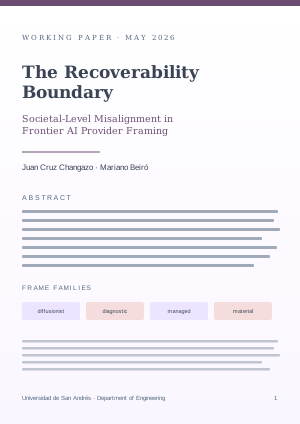
The Recoverability Boundary: Societal-Level Misalignment in Frontier AI Provider Framing

Juan Cruz Changazo, Mariano Beiró · May 2026

This paper reconstructs how major frontier AI providers framed the socioeconomic implications of advanced AI deployment during April 2025 to April 2026. Through an interpretive comparative analysis of official documents from OpenAI, Anthropic, Google, Microsoft, and Meta, it identifies four recurrent frame families: diffusionist adoption, diagnostic governance, managed disruption, and material absorption. Read across the corpus, these frames converge into a broader grammar of managed absorption: a recoverability-preserving language that translates disruption into problems of evidence, training, transition, infrastructure, and institutional redesign. This grammar remains bounded by institutional recoverability, the assumption that existing institutions can absorb frontier AI if they adapt quickly enough. The omitted paradigm is structural incompatibility, the possibility that some deployment paths may erode the institutions through which societies absorb technological change. The paper develops societal-level misalignment as a safety-relevant category for this gap between model-level success and institutional absorptive capacity.
Read paper Under peer reviewing

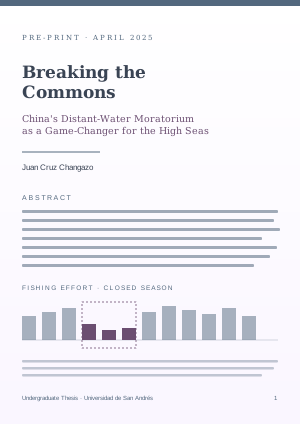
Breaking the Commons: China's Distant-Water Moratorium as a Game-Changer for High Seas Sustainability

Juan Cruz Changazo · April 2025

This study explores an unprecedented phenomenon in global fisheries governance: the “Voluntary Moratoria” that China applies to its distant-water fleet, far from its exclusive economic zone. Unlike typical coastal fishing bans, this unilateral three-month closure regulates squid jiggers, trawlers, and purse seiners in remote areas (Southwest Atlantic, Eastern Pacific, and Northern Indian Ocean), challenging classical notions of the “tragedy of the commons” and setting a surprising precedent on the high seas. This constitutes the first quantitative assessment of a unilateral fishing moratorium applied in distant waters, using millions of observations based on AIS data, with a statistical model including a control zone with no closure. The results confirm that Chinese vessels subject to the regulation drastically reduce their fishing effort during the closed season, alongside voluntary reductions by Chinese vessels not formally bound by the rule. However, the Chinese fleet (and foreign vessels) compensate for this drop in other periods, ultimately leading to an increase in total annual fishing effort. Our finding demonstrates that a dominant State can impose effective restrictions even in the absence of international agreements. The Moratorium succeeds in halting fishing at a critical time for species regeneration, but it also reveals key tensions: other actors might take advantage of reduced competition, while the Chinese fleet intensifies its activity in the remaining months. This unilateral initiative embodies a novel pathway for the sustainable management of common-pool resources on the high seas, while underscoring the need for broader coordination to achieve global sustainability.

Read paper